de la part des éditeurs
Résumé
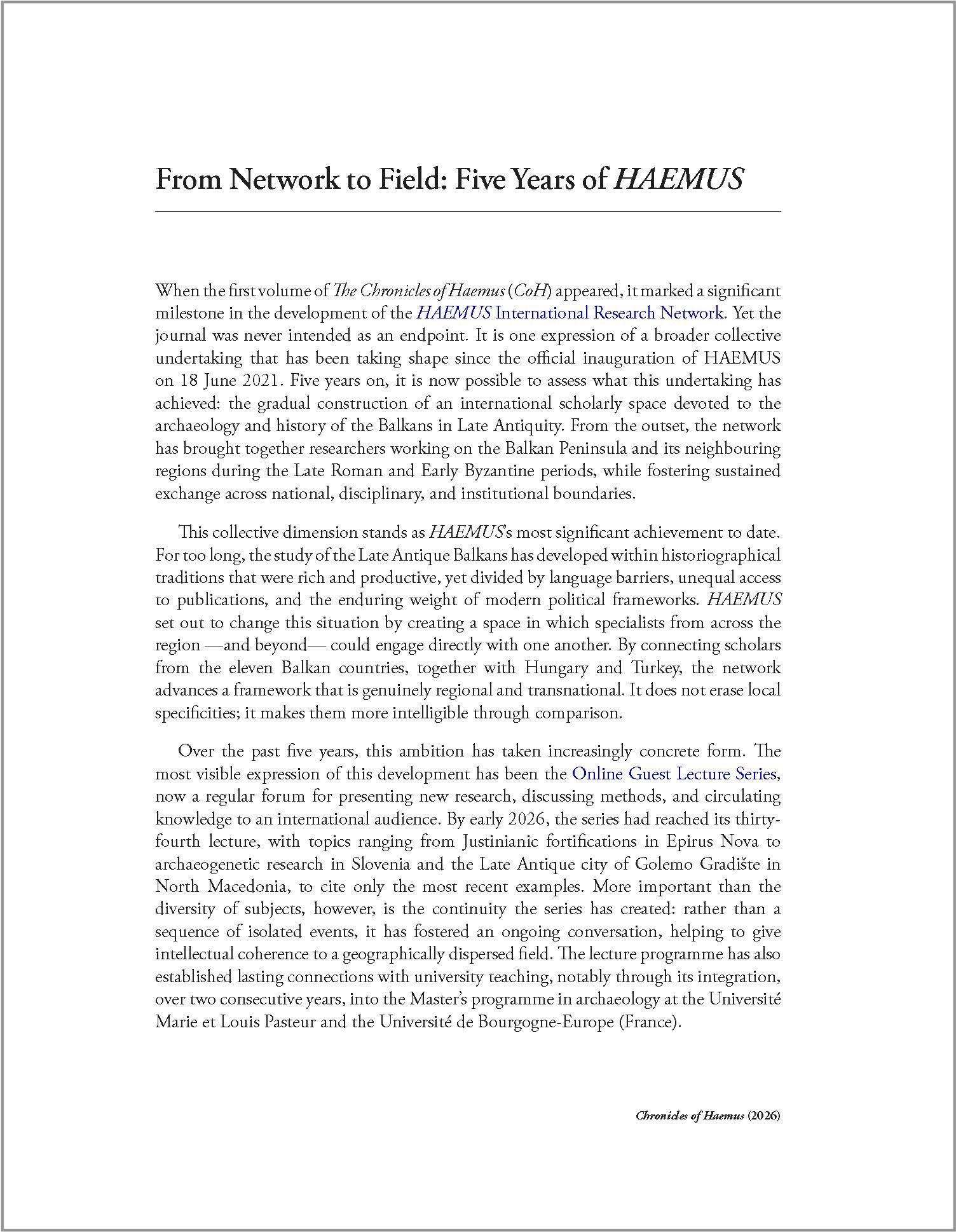
When the first volume of The Chronicles of Haemus (CoH) appeared, it marked a significant milestone in the development of the HAEMUS International Research Network. Yet the journal was never intended as an endpoint. It is one expression of a broader collective undertaking that has been taking shape since the official inauguration of HAEMUS on 18 June 2021. Five years on, it is now possible to assess what this undertaking has achieved: the gradual construction of an international scholarly space devoted to the archaeology and history of the Balkans in Late Antiquity. From the outset, the network has brought together researchers working on the Balkan Peninsula and its neighbouring regions during the Late Roman and Early Byzantine periods, while fostering sustained exchange across national, disciplinary, and institutional boundaries.
This collective dimension stands as HAEMUS’s most significant achievement to date. For too long, the study of the Late Antique Balkans has developed within historiographical traditions that were rich and productive, yet divided by language barriers, unequal access to publications, and the enduring weight of modern political frameworks. HAEMUS set out to change this situation by creating a space in which specialists from across the region —and beyond— could engage directly with one another. By connecting scholars from the eleven Balkan countries, together with Hungary and Turkey, the network advances a framework that is genuinely regional and transnational. It does not erase local specificities; rather, it makes them more intelligible through comparison.
Téléchargements
Publiée
Numéro
Rubrique
Licence
© The Chronicles of Haemus 2026

Ce travail est disponible sous licence Creative Commons Attribution - Pas d'Utilisation Commerciale - Pas de Modification 4.0 International.
Publication en libre accès
Creative Commons - Attribution - Pas d’Utilisation Commerciale - Pas de Modification 4.0 International - CC BY-NC-ND 4.0
Ce travail est publié sous un modèle de libre accès, sous la licence Creative Commons Attribution - Pas d’Utilisation Commerciale - Pas de Modification 4.0 International (CC BY-NC-ND 4.0).
Vous êtes libre de partager ce contenu à condition de créditer l’auteur de manière appropriée, de ne pas en faire un usage commercial et de ne pas le modifier de quelque manière que ce soit.