The Late Antique Church of Saint Demetrius in Sirmium: Problems of Evidence
Mihajlo N. Džamtovski
Universität Wien, Doctoral School of Historical and Cultural Studies (A).
The question of the Late Antique Church of Saint Demetrius in Sirmium (Sremska Mitrovica, Serbia) is a complex interdisciplinary issue involving archaeology, history, and hagiography. Saint Demetrius, martyred in Sirmium in 304, later became primarily associated with Thessaloniki, where his cult likely evolved after its transfer from Sirmium. Passio altera (BHG 497) states that the Praetorian Prefect Leontius built a church to Saint Demetrius in Sirmium near that of Saint Anastasia, whose existence is epigraphically confirmed, though its remains are unknown. Recent hagiographic scholarship questions the accuracy of the Passio altera (BHG 497) and reassess Justinian’s Novella 11 (535), the only sources naming Sirmium as the prefectural seat in the early 5th century. In light of this new research, this article re-evaluates all evidence for identifying the church at Site 59 in Sremska Mitrovica as that of Saint Demetrius.
L’identification de l’église paléochrétienne de Saint-Démétrius à Sirmium (Sremska Mitrovica, Serbie) soulève une problématique interdisciplinaire complexe, à la croisée de l’archéologie, de l’histoire et de l’hagiographie. Martyrisé à Sirmium en 304, saint Démétrius fut ensuite étroitement associé à Thessalonique, où son culte se développa vraisemblablement après son transfert depuis Sirmium. Selon la Passio altera (BHG 497), le préfet du prétoire Léontios aurait fait édifier à Sirmium une église dédiée au saint, à proximité de celle de Sainte Anastasie, dont l’existence est attestée par des inscriptions, bien que ses vestiges n’aient pas été identifiés. Les recherches hagiographiques récentes remettent cependant en cause la fiabilité de la Passio altera et réévaluent la Novelle 11 de Justinien (535), seules sources mentionnant Sirmium comme siège préfectoral au début du ve siècle. À la lumière de ces travaux, le présent article propose une réévaluation critique de l’ensemble des données permettant d’identifier l’église du site 59 de Sremska Mitrovica comme celle de Saint-Démétrius.
The modern city of Sremska Mitrovica in Serbia (ancient Sirmium) preserves in its name the memory of Saint Demetrius, a Late Antique martyr who continues to hold a central place in the city’s sacred landscape, as both the Serbian Orthodox church in the city centre and the Roman Catholic cathedral bear his name (fig. 1).
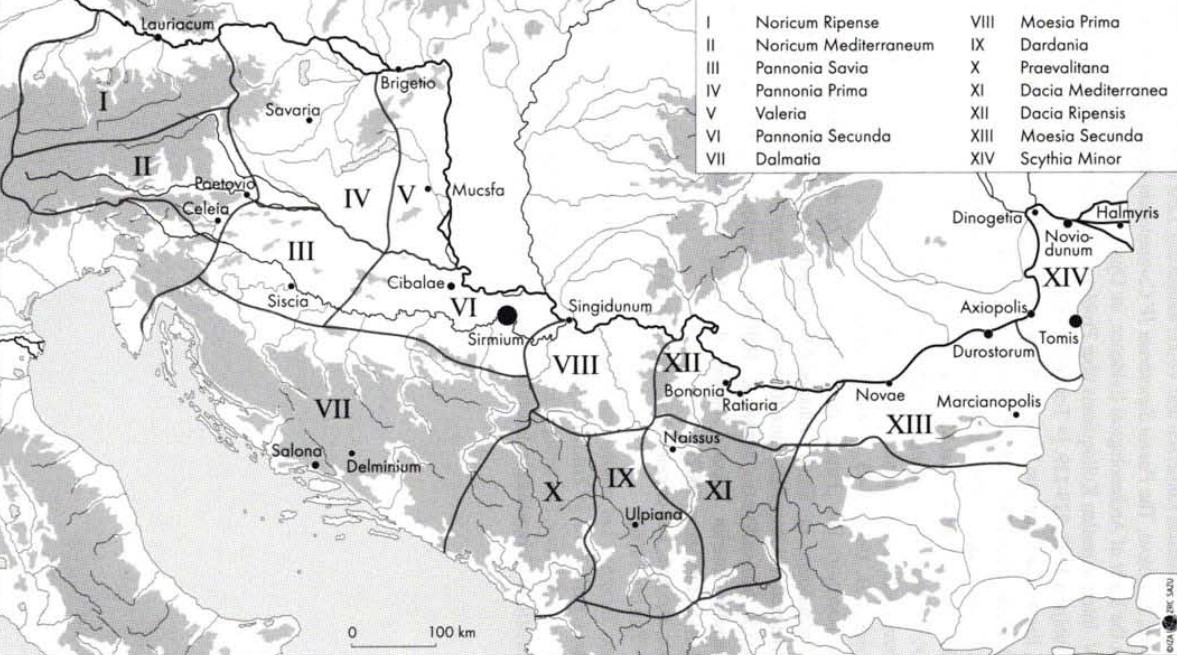
After Bratož 2004, p. 252, Anhang 2.
This central role of Saint Demetrius can be traced throughout the longue durée of Sremska Mitrovica’s history, as the medieval city bore the name Villa/Civitas Sancti Demetrii.11. Ћирковић 1969, (…) Moving from the present day back through the medieval period and further into Late Antiquity, we reach the era in which Saint Demetrius lived and died. His martyrdom, dated to 304,22. All dates are i (…) was recognised in Sirmium, where, according to the Passio altera (BHG 497), the Praetorian Prefect Leontius ordered a church dedicated to him to be constructed.33. Rizos (ed.) 201 (…)
However, recent scholarship examining the possible translatio of the cult of Saint Demetrius from Sirmium to Thessaloniki has raised doubts about the credibility of Novella 11 (De privilegiis Archiepiscopi Primae Iustinianae) issued by Emperor Justinian I (527–565) in 535—the only source that refers to Sirmium as the seat of the Praetorian Prefecture of Illyricum in the 5th century. Additionally, recent scholarship examining the possible translatio of the cult of Saint Demetrius from Sirmium to Thessaloniki has raised doubts about the literal reliability of the Passio altera (BHG 497), particularly concerning its account of the individual responsible for the construction of the Church of Saint Demetrius at Sirmium,44. Tóth 2010, p. 1 (…) traditionally linked to the transfer of what remained of Roman Pannonia to the Eastern Roman Empire after the Hunnic invasion.55. Поповић 2003 (1 (…)
In light of these differing interpretations, there is a need to re-evaluate the status quaestionis of this church, and the purpose of this study is to summarise the recent criticisms of the source pertaining to the construction of the church; and explore, within this newly established scholarly framework, the church excavated at Site 59 in Sirmium, which the majority of authors identify as the Church of Saint Demetrius,66. Поповић 2003 (1 (…) while others have expressed greater restraint due to the absence of epigraphic confirmation.77. Smirnov-Brkić 2 (…)
The greatest expansion of Sirmium occured during the Tetrarchic and Constantinian periods, when its strategically favourable location—close to, yet safely behind, the imperial frontier, and well connected with Dalmatia, Italy, northern Pannonia, and the central Balkans—was recognised by emperors who were frequently on the move. For these reasons, Sirmium was selected as one of the imperial residential centres of the Roman Empire. This status brought about extensive construction activity in both the city and its surrounding countryside, including the establishment of a mint, imperial arms and wool-processing workshops, an imperial palace, a hippodrome, and a horreum.88. Jeremić 2016, p (…)
Several emperors occasionally resided in Sirmium: Diocletian (284–305), Galerius (305–311), Constantine I (306–337), Licinius (308–324), and Constantius II (337–361). Finally, Emperor Theodosius I (379–395) was proclaimed in Sirmium.99. Seeck 1919, p. (…) The city’s economic situation began to deteriorate after the Battle of Adrianople in 378 (Edirne, Türkiye), initiating a gradual process of depopulation and disintegration of the previously well-established urban fabric. Finally, in 441, Sirmium was conquered by the Huns.1010. Поповић 2003 (1 (…)
In a period roughly from the late 3rd to the first third of the 4th century, series of administrative reforms were introduced, aimed at improving the efficiency of imperial governance, countering potential usurpers more effectively, and addressing the constant threats posed by external enemies. These reforms included the division of the existing provinces into smaller ones and their organisation into dioceses, which were in turn grouped into larger administrative entities known as prefectures.1111. Porena 2003, p. (…)
Sirmium belonged to the province of Pannonia Secunda, within the Diocese of Pannonia and the Praetorian Prefecture of Illyricum, Italy, and Africa. However, its administrative history during the period in question is complex. In the 4th century, the Dioceses of Pannonia, Dacia, and Macedonia formed a separate Praetorian Prefecture of Illyricum for several short intervals. The final division occurred a few years after the death of Emperor Theodosius I (379–395), when Pannonia became part of the Western Roman Empire and was not part of the Praetorian Prefecture of Illyricum of the pars Orientis.1212. Gračanin 2011, (…)
The transfer of Sirmium to the Eastern Roman Empire remains a debated issue in scholarship, both regarding its chronology (mid-420s versus 437) and its territorial scope. Some scholars emphasise the formal cession of 437, drawing primarily on mid-6th-century testimonies such as Cassiodorus’ Variae and Jordanes’ Romana.1313. Gračanin 2005, (…) Others, however, have suggested that eastern administrative control may have been established earlier, possibly already in 424/425, with 437 representing a subsequent legal formalisation rather than the initial transfer.1414. Moreau 2023, p. (…)
The 4th century was one of the most turbulent periods in the history of Christianity. It witnessed, first, a series of persecutions that ended with the Edict of Serdica in 311 and the so-called Edict of Milan in 313, which granted freedom of worship to Christians within the Roman Empire;1515. Машкин 1947, p. (…) and second, the Arian controversy—the debate over the nature of Christ and his relationship to God the Father—which led to the convening of the first two Ecumenical Councils: Nicaea in 325 (İznik, Türkiye) and Constantinople in 381 (Istanbul, Türkiye).1616. Острогорски 195 (…)
The traces of this long ecclesiastical drama are reflected in the history and archaeology of Sirmium, whose bishops were metropolitan bishops, since Sirmium was the capital of the Late Antique province of Pannonia Secunda.1717. Зелер 2005, p. (…) A significant number of martyrs lost their lives in Sirmium during the persecutions of the early 4th century. Some of these are: Syneros; Montanus, a presbyter from Singidunum (Belgrade, Serbia), and his wife Maxima; Irenaeus, the bishop; Demetrius, his deacon (who will be discussed in more detail later in this paper); the deacons Fortunatus and Donatus; seven anonymous virgins; Sabbatia; Agrippinus; Secundus; Ursicinus; Basilla; Anastasia; and many others.1818. Bratož 2004, p. (…) The veneration of some of these martyrs is attested in the Late Antique epigraphy and Christian topography of Sirmium, subjects to be discussed further in this paper. Additionally, Sirmium itself became a battleground during the Arian controversy, hosting several—mostly pro-Arian—synods: in 347/348 (disputed), 351, 357, 358, and possibly in 378.1919. Cedilnik 2004, (…) Finally, a number of bishops are documented in Sirmium from the onset of the 4th century to the Hunnic conquest of 441, demonstrating a continuous ecclesiastical organisation in the city during the period in question (T. 1).2020. Зелер 2005, p. (…)
| BISHOPS | YEARS | NOTES |
| Irenaeus | ? – 304 | Martyr |
| Domnus/Domnio | 325 – c. 335 | Pro-Nicene |
| Eutherius | c. 335 – c. 343 | Pro-Arian |
| Photinus | c. 343 – 351 | Pro-Arian |
| Germinius | 351 – c. 376 | Pro-Arian; Pro-Nicene later |
| Anemius | 376/377 – c. 392 | Pro-Nicene |
| Cornelius | c. 392 – c. 409 | / |
| Laurentius | 401 – 417 | Seniensi corrupt form of Sirmium? |
| Anon. | ? – 441 | Left Sirmium |
Made by the author.
The Christian topography of Late Antique Sirmium was shaped by the veneration and commemoration of martyrs and is known through the existence of several structures, so far mostly documented in the exurban areas of Sirmium.2121. Шпехар 2014, p. (…) These objects are as follows (figs. 2–3):
- The Church of Saint Syneros, a martyrium, is a single-nave structure with a vestibule and one apse, located on the northern necropolis of Sirmium. Surrounded by graves and containing burials within, it was constructed in the mid-4th century. Its existence is confirmed by two inscriptions.2222. Шпехар 2014, p. (…)
- The Church of Saint Anastasia, apart from its mention in the Passio altera (BHG 497),2323. Rizos (ed.) 201 (…) is also known from a single inscription dated between 330 and 400, while its exact findspot remains uncertain. Two hypotheses have been proposed regarding its location. The first, advanced by Miroslav Jeremić, suggests that the pagan temple at Site 47, near the church at Site 59, was converted into a church, as two distinct necropoleis developed around these structures. However, due to the absence of epigraphic confirmation, M. Jeremić ultimately concluded that the Church of Saint Anastasia could correspond to either of these buildings—the same uncertainty applying to the Church of Saint Demetrius, believed to have been built adjacent to it. The second hypothesis, proposed by Ivana Popović and Snežana Ferjančić, connects the Church of Saint Anastasia with a rectangular structure featuring an apse and surrounded by graves, both inside and outside (Site 60). This site is located extra muros north of the city walls and the building was destroyed in the 19th century. Their argument is based on the popularity of Saint Anastasia among the Ostrogoths and on the discovery of several Ostrogothic coins from the first half of the 6th century near the northern wall of Sirmium.2424. Jeremić 2006, p (…)
- The Church of Saint Irenaeus, a martyrium, is a single-nave structure with one apse, located on the eastern necropolis of Sirmium. Surrounded by graves and containing burials within, it was constructed between 330 and 341. Its existence is confirmed by one inscription.2525. Guyon, Jeremić (…)
- The memorial structure on the eastern necropolis is a building whose plan remains unknown, though the author who published the excavation results suggested it may have had a trefoil layout. Its construction is dated between 311/317 and 334/335, and it was built above Tomb 20, which features a depiction of the Good Shepherd and dates to the last third of the 3rd century. The erection of this structure indicates that inhumations continued both within and around it, as evidenced by the ongoing use of Tomb 20 until the reign of Emperor Jovian (363–364) and by the subsequent construction of Tombs 15, 16, and 17 nearby.2626. Lučić 2022, p. (…)
- The trefoil structure with a vestibule on the eastern necropolis was not properly excavated, and much of the associated data—such as information about the burials within and around the presumed martyrium—has been lost. Its precise dating remains unknown.2727. Јеремић 2004, p (…)
- Adjacent to the trefoil structure is a single-nave church with a vestibule, often referred to as a chapel. Improper excavation has resulted in the loss of much of the associated data, and its precise dating remains unknown.2828. Јеремић 2004, p (…)
- A Christian structure—possibly a martyrium—was built in the first half of the 4th century on the site of Zidine/Širingrad in Mačvanska Mitrovica, located today on the opposite bank of the Sava River from Sremska Mitrovica. In Antiquity, however, this area was a river island most likely connected to Sirmium with a bridge. The necropolis surrounded the structure.2929. Поповић 2003 (1 (…)
- Lastly, there is a 5th-century urban church on Site 59 with burials inside and around it. Since this church is usually connected with the Church of Saint Demetrius, more attention to its description will be given later in the text.
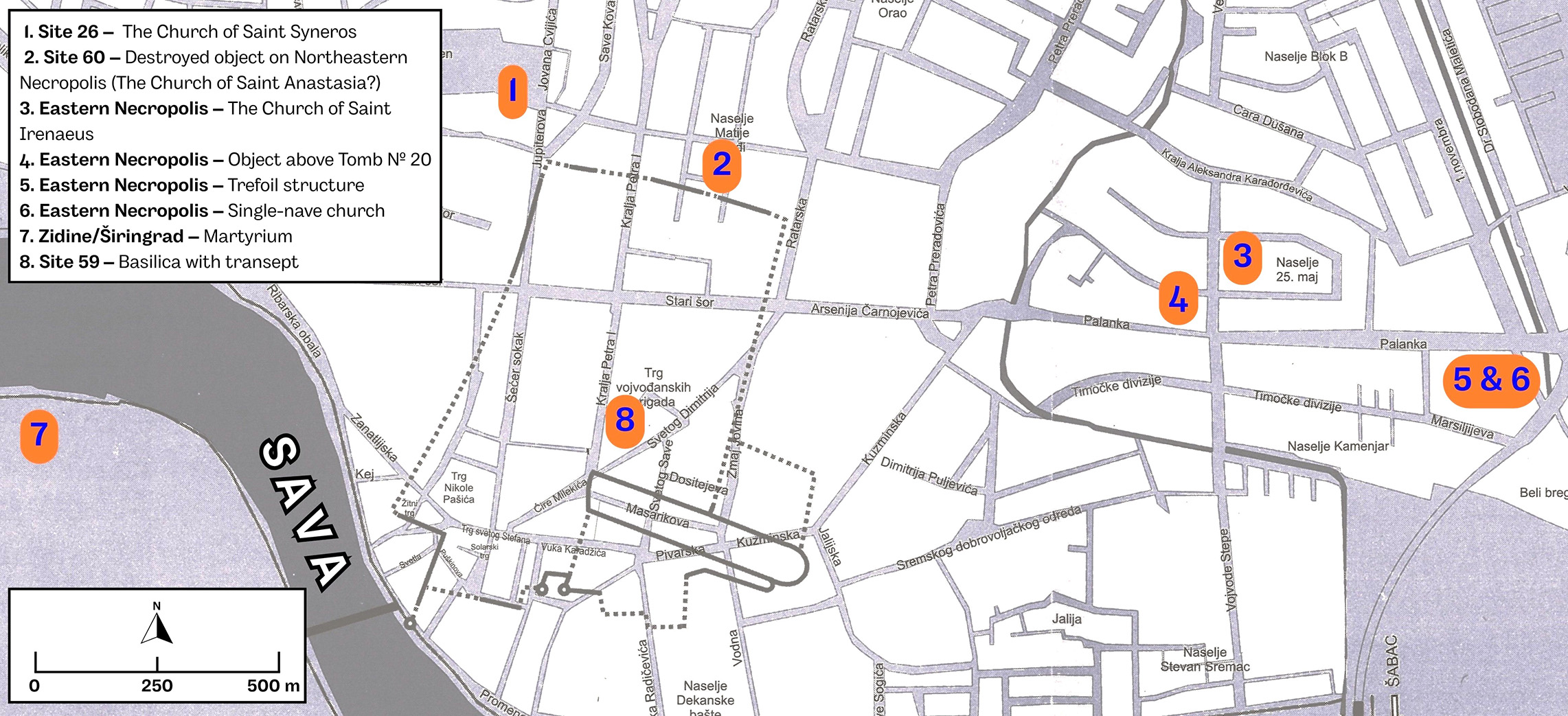
After Miladinović-Radmilović 2011, Map 6; edited by the author.
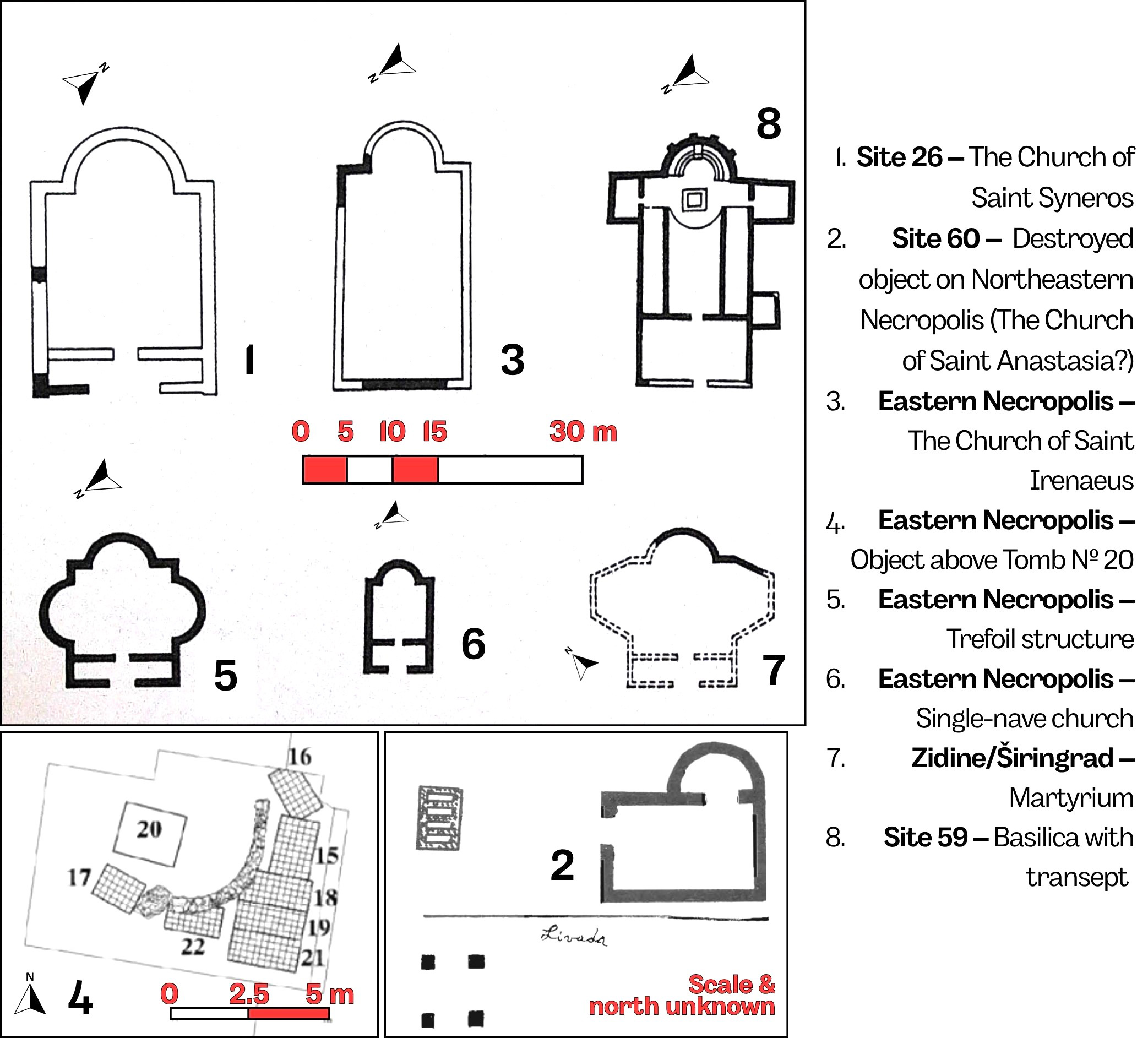
After Милошевић 2001, p. 183; Јеремић 2004, p. 46, fig. 3; and Lučić 2025, p. 74; edited by the author.
Saint Demetrius is one of the widely recognised saints, mainly venerated in Eastern Orthodox and Catholic churches. In early iconography, he was represented as a civil servant, but eventually evolved into a military saint and is represented as a soldier.3030. Kousouros 2000, (…)
But what exactly is the story behind his martyrdom and what is his connection to Late Antique Sirmium? The question of his veneration in both Sirmium and Thessaloniki, as well as the differing accounts in his Passiones, has long been a subject of debate and a source of confusion among scholars.3131. Tóth 2010, p. 1 (…) The veneration of Saint Demetrius—the patron saint of both Sremska Mitrovica and Thessaloniki—was most likely transferred to Thessaloniki from Sirmium, but that his Pannonian background was overshadowed by the local context. The discrepancies between the “biographies” of Saint Demetrius in the Passio Pollionis and the Passio altera are explained by the fact that the defining element in the development of his cult in Thessaloniki was the location of his shrine, which was built over a former bathhouse. Bathhouses were closely associated with pre-Christian civic and religious life in Thessaloniki, particularly with the worship of the city’s tutelary deity, Cabirus.3232. Tóth 2010, p. 1 (…) As the Passio altera (BHG 497) describes Demetrius’s death in the subterranean chambers of the bathhouse, it is possible that his cult in Thessaloniki represents a Christianised adaptation of the earlier cult of Cabirus.3333. Rizos 2016, p. (…)
The only source that mentions the construction of church dedicated to him in Sirmium is the Passio altera (BHG 497). The English translation is as follows:3434. “Μέλλων δὲ ἀπέρ (…)
Now, planning to leave for Illyricum, he wished to take some of the relics of the martyr, in order to build also there a temple in the name of the saint. But the most glorious champion of Christ Demetrios appeared to him at night and deterred him from proceeding. He thus took his chlamys, which was covered with the holy blood, and a part of the orarion [handkerchief or stole?], and he made a silver casket (glossokomon) and placed them into it. On his way, severe winter broke out, and, the river Danube rumbled with strong current, so that its crossing was impossible even by boat for several days. And, as it was not calming down, but blocked the continuation of the journey, the Prefect was in distress. But then he saw the most glorious Demetrios telling him: “Give up all incredulity and distress, take up what you are carrying, and cross the river without hesitating!” So, at dusk, he got onto his vehicle holding in his hands the precious coffin (soros), and crossed the river in safety. Thus he arrived at Sirmium and placed the holy coffin with the treasure it contained at the most holy temple of the holy martyr Demetrios, which he built there, by the venerable house of the rightly victorious martyr Anastasia. And the Lord also performed many miracles and healings at every part of the journey where the vehicle and the animals stopped. By the grace and mercy and love for mankind of our Lord Jesus Christ, to whom be glory and power now and forever and to the ages of ages. Amen.
Some authors of the hagiographic studies from this century, however, doubt the existence of the Praetorian Prefect Leontius in 5th-century Sirmium. Their arguments are as follows:
- There is no evidence for the existence of the Praetorian Prefect Leontius in the period of second quarter of the 5th century, although both the Passio prima (BHG 495) and the Passio altera (BHG 497) state that the Praetorian Prefect Leontius ordered the construction of the Church of Saint Demetrius in Thessaloniki. On the other hand, the church in Thessaloniki has a phase from the early 6th century, and a certain Praetorian Prefect Leontius (most likely connected to the Praetorian Prefecture of Illyricum, according to Jean-Michel Spieser) is mentioned in several sources connected to the year 510. This, combined with the author of the Passio altera (BHG 497) possibly being aware that Sirmium had once served as the seat of the prefecture, may have contributed to shaping the legend in that particular form.3535. Spieser 1984, p (…)
- According to P. Tóth, it is possible that Justinian I distorted the facts in Novella 11 in order to justify transferring the seat of the prefecture from Thessaloniki to the newly established Iustiniana Prima (Caričin Grad – Prekopčelica, Serbia).3636. Tóth 2010, p. 1 (…) On the other hand, E. Rizos believes that the name of the prefect mentioned in Novella 11 as departing from Sirmium, Apraeemius, is likely a historical error and a corruption of the name of the last Praetorian Prefect of Illyricum and Africa around 395 before its transfer to Thessaloniki, Apodemius.3737. Rizos 2016, p. (…)
Truly, these arguments are difficult to counter with firm and clear evidence. Apart from the mentioned sources about the seat of the Praetorian Prefecture of Illyricum in the second quarter of the 5th-century in Sirmium (Novella 11 and Passio altera [BHG 497]), no sources confirm this. However, known data that could be used for the potential defense of Novella 11 and Passio altera (BHG 497) is as follows:
- Novella 11 mentions church administration abandoning Sirmium because of the Hunnic attack of 441.3838. Nov. 11; Miller (…) A bishop of unknown name in Sirmium in 441 is testified by Priscus of Panius.3939. Priscus, Fragme (…) Weak side of this is that the presence of a bishop does not imply the seat of the prefecture in Sirmium in the mentioned period.
- The translators and commentators of the Novella 11 believe that Apraeemius is latinised version of the Syriac name Ephrem.4040. Nov. 11; Miller (…) However, when searching in PLRE II, no information about potential Praetorian Prefect Ephrem could be found.4141. Martindale 1980 (…)
- The Passio altera (BHG 497) states that the Church of Saint Demetrius was built next to the Church of Saint Anastasia, whose existence is confirmed by a 4th-century inscription found at an unknown location in Sirmium.4242. Rizos (ed.) 201 (…) However, a possible weakness of this argument is that the relics of Saint Anastasia were transferred from Sirmium to Constantinople in the second half of the 5th century, which may suggest that the author of the Passio altera was familiar with the Christian topography of 5th-century Sirmium, even though the legend which connects Saint Anastasia with Sirmium was known in Rome and not in Thessaloniki/Constantinople in the Late Antique period.4343. Vedriš 2007, p. (…)
Owing to the dubious nature of the hagiographic sources—which, while containing elements of historical truth, are not always precise—4444. Smirnov-Brkić 2 (…) and the absence of additional evidence confirming the presence of the Praetorian Prefect Leontius in Sirmium during the second quarter of the 5th century, it remains difficult to reach a definitive conclusion. The counterarguments are not strong enough to refute the views of P. Tóth and E. Rizos, and point towards the fact that their views are most likely correct, i.e. that the seat of the Praetorian Prefecture of Illyricum was not in Sirmium in the second quarter of the 5th century.
The church on Site 59, located at 10 Kralja Petra I Street in Sremska Mitrovica, was uncovered during excavations in 1978 and 1981. The investigations revealed that the church had been constructed on the foundations of an earlier building. Today, its remains are preserved within a glass-enclosed area, accessible to visitors inside a modern structure in the city centre (fig. 4). A coin dated to 394–402 was discovered in the layer between the floor of the underlying building and the church’s apse, providing a terminus post quem for the construction of the church.4545. Милошевић 1994, (…)
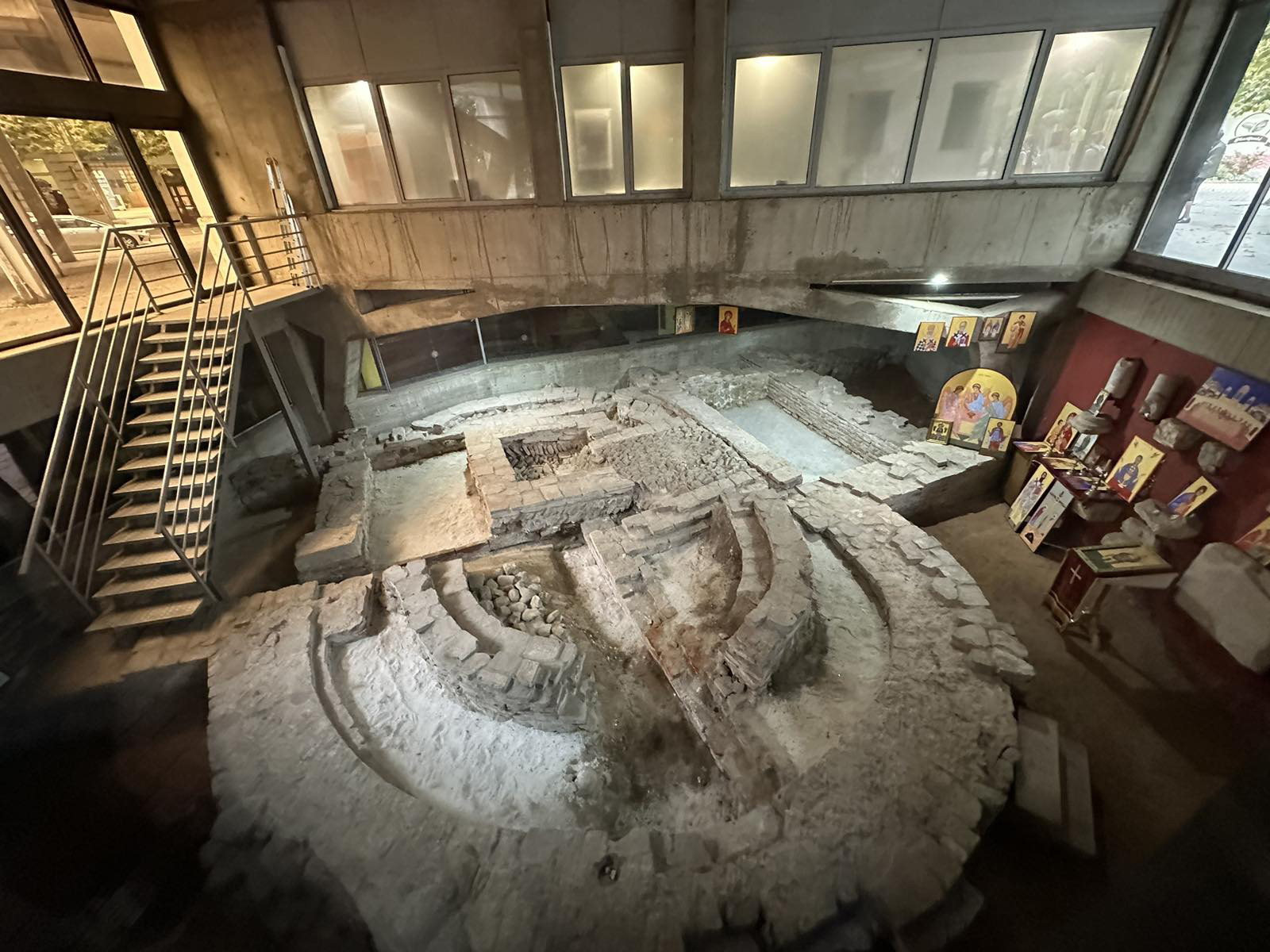
© Jovan Milinković; used with permission.
It is likely that the church was constructed above the remains of a pagan temple, which was located in the central area of Sirmium, on the southern periphery of the forum.4646. Jeremić 2006, p (…) There are, however, several issues concerning the position of the church within the urban context and topograhy of 5th-century Sirmium. It is generally assumed that a reduction of the urban area of Sirmium occurred in the early 5th century. This conclusion is based on the concentration of archaeological finds in the southern half of the city and on the presence of a wall at Site 54, located c. 50 m north of the church, which has been interpreted as the new northern boundary of the reduced urban area. This wall, however, is only briefly mentioned in the literature, and its function remains poorly understood.4747. Поповић 2003 (1 (…) Moreover, newly identified finds of semi-processed bones and antlers dated to 5th–6th century period are located north of this presumed “new” wall, in 91A Stari Šor Street.4848. Lučić 2025, p. (…) This evidence complicates the interpretation of the wall as a definitive urban boundary and leaves the question of the spatial reduction of Sirmium open.
Parts of the church were constructed using reused broken bricks, an indicator of the urban decline that affected Sirmium from the late 4th century onwards.4949. Јеремић 2002, p (…) As the total length of the structure could not be excavated, the dimensions of the narthex remain unknown. The naos measures 11.25 metres in width and 15.30 metres in its preserved length. The building was a three-aisled basilica. The stylobates of the colonnades separating the aisles were founded on the levelled walls of an earlier structure. The transept and the single apse of the church were founded on wooden stakes. The apse measures 6.25 metres in width, and the altar area was elevated above the rest of the interior. Within the apse, a brick-built synthronon was uncovered, although no traces of the cathedra episcopalis were registered (fig. 5).5050. Поповић 2003 (1 (…)
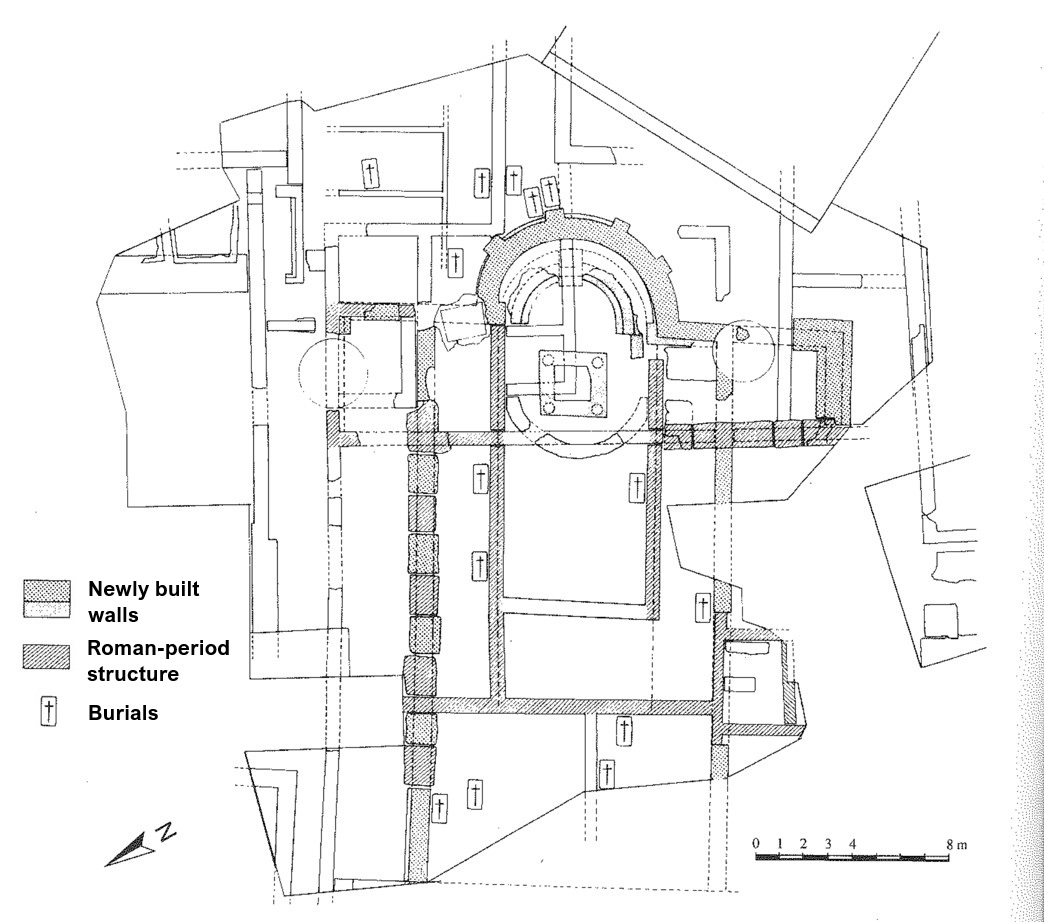
After Поповић 2003 (1987), p. 214, fig. 3; edited by the author.
A basilica with transept is not characteristic for church architecture of Late Roman Pannonian provinces.5151. Gáspár 2002, p. (…) This form is most prevalent in provinces located in present-day Greece and Asia Minor during the 5th and 6th centuries, but can also be found in present-day Albania, Bulgaria, the Levant, and along the North African coast in the mentioned period.5252. Stein 2006, p. (…) This could mean that the church on Site 59 was built by people coming from these areas.5353. V. Popović emph (…)
A necropolis developed both inside and around the church, containing a total of 30 burials dug into a layer of 4th-century rubble. The necropolis began developing after the construction of the church and was located in the church (the naos and the narthex area) and its direct surroundigs (northeast of the apse) (Site 59). After that it spread to include sites 46 and 47 (east and northeast of the church) (fig. 6). Graves were mostly constructed of bricks with either flat or gabled covers. In addition, two small sarcophagi were discovered within the church.5454. Popović 2012, p (…)
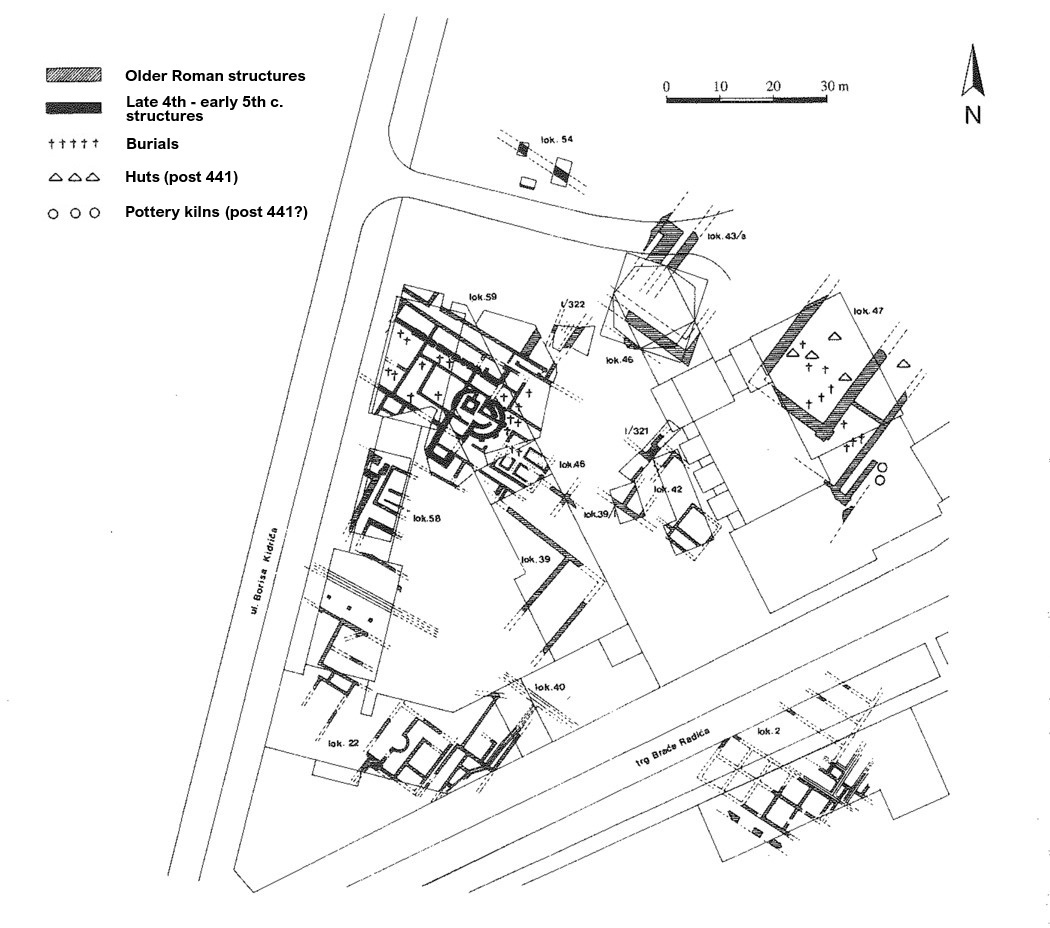
After Поповић 2003 (1987), p. 216, fig. 4.
Five burials from extra muros cemeteries were likely reinterred in this necropolis. According to Vladislav Popović, this reflected the anxiety and insecurity experienced during the troubled period of the late 4th and early 5th centuries.5555. Поповић 2003 (1 (…)
Grave goods included late 4th-century coins, a knife, 5th-century fibulae, and bone combs. The upper layers of the church were disturbed by Ottoman-period horizons, which prevented the establishment of a complete stratigraphic sequence and, consequently, a secure chronology of the building. The finds from the necropolis suggest that the burials ceased after the Hunnic attack of 441 and were not resumed thereafter.5656. Popović 2012, p (…)
The majority of authors consider this church to be the one dedicated to Saint Demetrius,5757. Милошевић 1994, (…) following the assumption of V. Popović.5858. Поповић 2003 (1 (…) Yet, there are those who show certain degree of reservation towards such identification.5959. Jeremić 2006, p (…)
At the present state of research, it appears that the church on Site 59 most likely cannot be identified with the one from the Passio Altera (BHG 497). The arguments are as follows:
- There is no firm evidence that a Praetorian Prefect Leontius was active in Sirmium during the second quarter of the 5th century, nor that the city functioned at that time as the seat of the Praetorian Prefecture of Illyricum. The arguments of P. Tóth and E. Rizos suggest that both the Passio altera (BHG 497) and Novella 11 contain historical conflations, combining the memory of Sirmium as a prefectural seat around 395 with that of Leontius in Thessaloniki in the early 6th century.6060. Tóth 2010, p. 1 (…) If the presumed activity of Praetorian Prefect Leontius in Sirmium in the second quarter of the 5th century is taken as the sole prerequisite for identifying a Late Antique church of Saint Demetrius on Site 59, then, in light of these arguments, such an identification must remain unconfirmed unless supported by new evidence.
- The absence of epigraphic material likewise prevents the secure attribution of the church to any specific saint at present.
The only remaining possibility that the church on Site 59 could correspond to the one mentioned in the Passio altera (BHG 497) and be identified as the church of Saint Demetrius lies in the suggestion, emphasised by P. Tóth, that hagiographic narratives may retrospectively attach new stories to already existing buildings or traditions. It therefore remains possible that the church on Site 59 was indeed the church of Saint Demetrius, around which such a later hagiographic narrative was constructed,6161. Tóth 2010, p. 1 (…) although this can only be confirmed by future archaeological or epigraphic evidence.
In summary, if new sources or inscriptions were to demonstrate that the Praetorian Prefect Leontius was indeed active in Sirmium during this period, the question could be reopened. Until such evidence emerges, however, the available data support the conclusions reached in this paper.
The investigation of the Late Antique Church of Saint Demetrius in Sirmium demonstrates how closely intertwined archaeological, historical, and hagiographical evidence must be treated when reconstructing the Christian topography of Late Antique cities. The long-standing identification of the basilica on Site 59 with the church mentioned in the Passio altera (BHG 497) rests on a chain of assumptions that require reconsideration in light of recent scholarship.
The arguments advanced by P. Tóth and E. Rizos strongly suggest that both the Passio altera (BHG 497) and Justinian’s Novella 11 preserve conflated or anachronistic memories, combining the role of Sirmium as a prefectural seat around 395 with the presumed activity of the Praetorian Prefect Leontius in Thessaloniki in the early 6th century. In the absence of independent confirmation that a Praetorian Prefect named Leontius was active in Sirmium the second quarter of the 5th century, the historical basis for a 5th-century foundation of a Church of Saint Demetrius in the city remains insecure.
The archaeological evidence from Site 59 likewise does not compel such an identification. While the basilica is clearly a 5th-century urban church with a necropolis developing within and around it, no evidence allows it to be connected securely with a specific saint. The lack of epigraphic evidence is particularly decisive in this regard.
Taken together, the current state of evidence does not permit the secure identification of the church on Site 59 with the Church of Saint Demetrius described in the Passio altera (BHG 497). While the memory of Saint Demetrius remained deeply embedded in the later Christian landscape and identity of Sirmium, the archaeological and historical data available at present do not allow the localisation of his Late Antique church within the excavated remains. Only the discovery of new written sources or epigraphic material, particularly evidence for the activity of Leontius in Sirmium during the second quarter of the 5th century or a direct dedication to Saint Demetrius, would justify reopening this question.
This work was presented at the conference named From Nicaea to the Present Day (325–2025). The Lasting Importance of the First Ecumenical Council, held in Belgrade (Serbia) from the 11th to the 12th of December 2025. The author would like to express his gratitude to Jasmina S. Ćirić, Hrvoje Gračanin, Jovan Milinković, Dominic Moreau, and two anonymous reviewers for their assistance and useful comments.
Баришић 1955 = Фрањо Баришић, “Приск”, in Георгије Острогорски (ed), Византијски извори за историју народа Југославије I, Београд, Издавачко предузеће, Посебна издања CCXLI, Византолошки институт 3, 1955, p. 7–16.
Miller, Sarris (eds) 2018 = David J. D. Miller, Peter Sarris, The Novels of Justinian. A Complete Annotated English Translation, Cambridge, CUP, 2018.
Pharr (ed.) 1952 = Clyde Pharr, The Theodosian Code and Novels and the Sirmondian Constitutions. A Translation with Commentary, Glossary, and Bibliography, Princeton (NJ), PUP, The Corpus of Roman Law (Corpus Juris Romani) 1, 1952.
Rizos (ed.) 2016 = Efthymios Rizos, Martyrdom of Demetrios of Thessalonike (Passio Altera; BHG 497), 2016, online http://csla.history.ox.ac.uk/record.php?recid=E01344, consulted 24 October 2025.
Bratož 2004 = Rajko Bratož, “Die diokletianische Christenverfolgung in den Donau- und Balkanprovinzen”, in Alexander Demandt, Andreas Goltz, Heinrich Schlange-Schöningen (eds), Diokletian und die Tetrarchie: Aspekte einer Zeitenwende, Berlin, New York (NY), Walter de Gruyter, Millennium-Studien zu Kultur und Geschichte des ersten Jahrtausends n. Chr. 1, 2004, p. 115–140, 209–252.
Bratož 2014 = Rajko Bratož, Med Italijo in Ilirikom. Slovenski prostor in njegovo sosedstvo v pozni antiki, Ljubljana, Znanstvena založba Filozofske fakultete, Zveza zgodovinskih društev Slovenije, Slovenska akademija znanosti in umetnosti, Dela I. razreda Slovenske akademije znanosti in umetnosti 39, Zbirka Zgodovinskega časopisa 46, 2014.
Cedilnik 2004 = Alenka Cedilnik, Ilirik med Konstantinom Velikim in Teodozijem Velikim. Balkansko-Podonavski prostor v poročilih Atanazija, Hilarija, Sokrata Sholastika, Sozomena, Teodoreta in Filostorgija, Ljubljana, Zgodovinski inštitut Milka Kosa ZRC SAZU, Thesaurus Memoriae Dissertationes 3, 2004.
Ћирковић 1969 = Сима М. Ћирковић, “Civitas Sanctii Demetrii”, in Радомир Прица (ed.), Сремска Митровица, Сремска Митровица, Скупштина Општине Сремска Митровица, Музеј Срема, 1969, p. 59–69.
DePalma Digeser 2014 = Elizabeth DePalma Digeser, “Why has the Edict of AD 311 been ignored?”, in Vesselina Vachkova, Dimitar Dimitrov (eds), Serdica Edict (311 AD): Concepts and Realizations of the Idea of Religious Toleration, Sofia, TANGRA TanNakRa Publishing House Ltd. (Centre for Research on the Bulgarians), 2014, p. 15–27.
Dimitrijević, Whitehouse 2022 = Milijan Dimitrijević, John Whitehouse, “Textile Manufacturing, Wool Production and Sheep Grazing during the Roman Empire in Pannonia Secunda near Sirmium”, Vjesnik Arheološkog muzeja u Zagrebu LV, 2022, p. 115–132.
Džamtovski 2025 = Mihajlo N. Džamtovski, “A Prayer in Clay: a note on brickmaking in late 6th-century Sirmium”, Annales Instituti Archeologici XXI, 2025, p. 242–255.
Džamtovski, Whitehouse 2025 = Mihajlo N. Džamtovski, John Whitehouse, “The Roman imperial weapons factory in Sirmium”, in Balázs Komoróczy, Martijn Wijnhoven (eds), Body Armour and Other Defensive Equipment. 21st Roman Military Equipment Conference. Brno, 2–6 June 2025. Book of Abstracts, Brno, Czech Academy of Sciences, Institute of Archaeology, Brno, 2025, p. 8–9.
Eremić 2023 = Dragana Eremić, The Mint of Sirmium – A Roman Moneta and Its Place within Late Roman Coinage Administration. A Study of Production and Circulation, Sremska Mitrovica, Blago Sirmijuma, 2023.
Фајфрић 2021 = Борис Ж. Фајфрић, Страдање сирмијумских мученика и развој њиховог култа. Историјско – богословска анализа, doctoral thesis, Универзитет у Београду, 2021.
Fasola, Fiocchi Nicolai 1989 = Umberto M. Fasola, Vincenzo Fiocchi Nicolai, “Le necropoli durante la formazione della città cristiana”, in Noël Duval (ed.), Actes du XIe congrès international d'archéologie chrétienne. Lyon, Vienne, Grenoble, Genève, Aoste, 21-28 septembre 1986. Volume III, Rome, École Française de Rome, Publications de l'École française de Rome 123, 1989, p. 1153–1205.
Fiocchi Nicolai 2003 = Vincenzo Fiocchi Nicolai, “Elementi di trasformazione dello spazio funerario tra tarda antichità ed altomedioevo”, in Uomo e spazio nell’alto medioevo. 4–8 aprile 2002. Tomo secondo, Spoleto, Centro italiano di studi sull'alto Medioevo, Settimane di studio del Centro italiano di studi sull'alto Medioevo L, 2003, p. 921–969.
Gáspár 2002 = Dorottya Gáspár, Christianity in Roman Pannonia. An evaluation of Early Christian finds and sites from Hungary, Oxford, BAR Publishing, Bar International Series 1010, 2002.
Gračanin 2005 = Hrvoje Gračanin, “Huni i južna Panonija”, Scrinia Slavonica 5, 2005, p. 9–47.
Gračanin 2011 = Hrvoje Gračanin, Južna Panonija u kasnoj antici i ranom srednjovjekovlju (od konca 4. do konca 11. stoljeća), Zagreb, Plejada, 2011.
Gračanin 2013 = Hrvoje Gračanin, “Crkveni ustroj u kasnoantičkoj južnoj Panoniji” in Bruna Kuntić-Makvić, Inga Vilogorac Brčić (eds), Znakovi i riječi. Signa et litterae vol. IV. Zbornik projekta »Mythos – cultus – imagines deorum«. De ritv ad religionem. Od obreda do vjere, Zagreb, FF Press, 2013, p. 155–169.
Guyon, Ferjančić 2022 = Jean Guyon, Snežana Ferjančić, “Les inscriptions”, in Ivana Popović, Miloje Vasić, Jean Guyon, Dominic Moreau (eds), La basilique Saint-Irénée de Sirmium et sa nécropole, Turnhout, Brepols, Rome and After in Central and Eastern Europe 1, 2022, p. 117–149.
Guyon, Jeremić 2022 = Jean Guyon, Miroslav Jeremić, “Les tombes de la basilique Saint-Irénée et de sa nécropole”, in Ivana Popović, Miloje Vasić, Jean Guyon, Dominic Moreau (eds), La basilique Saint-Irénée de Sirmium et sa nécropole, Turnhout, Brepols, Rome and After in Central and Eastern Europe 1, 2022, p. 51–91.
Heinrich-Tamáska 2015 = Orsolya Heinrich-Tamáska, “Civitates et castra im Lichte der Kontinuitätsforschung: zwei Beispiele aus Pannonien (5.–7. Jh. n. Chr.)”, in Orsolya Heinrich-Tamáska, Hajnalka Herold, Peter Straub, Tivadar Vida (eds), „Castellum, civitas, urbs“. Zentren und Eliten im frühmittelalterlichen Ostmitteleuropa, Budapest, Leipzig, Keszthely, Rahden/Westf., Verlag Marie Leidorf GmbH, Castellum Pannonicum Pelsonense 6, 2015, p. 45–69.
Ivanišević, Bugarski 2018 = Vujadin Ivanišević, Ivan Bugarski, “Transformation of burial space in the cities of Northern Illyricum during the Late Antiquity”, Antaeus 35–36, 2018, p. 91–117.
Јеремић 2002 = Мирослав Јеремић, “Градитељство Сирмијума у V и VI веку на примеру градске цркве, као и грађевина на северном тракту хиподрома”, Саопштења XXXIV, 2002, p. 43–58.
Јеремић 2004 = Мирослав Јеремић, “Култне грађевине хришћанског Сирмијума”, in Душан Познановић (ed.), Sirmium и на небу и на земљи, Сремска Митровица, Благо Сирмијума, 2004, p. 43–73.
Jeremić 2006 = Miroslav Jeremić, “Les temples payens de Sirmium”, Starinar LVI, 2006, p. 167–200.
Jeremić 2016 = Miroslav Jeremić, Sirmium – Grad na vodi. Razvoj urbanizma i arhitekture od I do VI veka, Beograd, Arheološki institut Beograd, Posebna izdanja 59, 2016.
Kalhous 2009 = David Kalhous, “The significance of the Sirmian and apostolic tradition in shaping Moravian episcopal organization”, Early Medieval Europe 17.3, 2009, p. 268–285.
Kaplarević 2015 = Marko Kaplarević, “Frühchristliche Archäologie in Serbien. Forschungsgeschichte und aktueller Stand”, in Renate J. Pillinger (ed.), Neue Forschungen zum frühen Christentum in den Balkanländern, Wien, Verlag der ÖAW, Denkschriften der philosophisch-historischen Klasse 484, Archäologische Forschungen 26, 2015, p. 83–91.
Kelly 2014 = John N. D. Kelly, Early Christian Creeds. 3rd ed., London, New York (NY), Routledge, 2014.
Kiss 2019 = Attila P. Kiss, “Between Wotan and Christ? Deconstruction of the the Gepidic belief system based on the written and archaeological sources”, in Tivadar Vida, Dieter Quast, Zsófia Rácz, István Koncz (eds), Kollaps – Neuordnung – Kontinuität. Gepiden nach dem Untergang des Hunnenreiches. Tagungsakten der Internationalen Konferenz an der Eötvös Loránd Universität Budapest, 14. – 15. Dezember 2015, Budapest, Archaeolingua, 2019, p. 369–407.
Kousouros 2000 = Lena Kousouros, Saint Demetrios of Thessaloniki, MPhil dissertation, University of Glasgow, 2000.
Kovács 2014 = Péter Kovács, Die antiken Quellen zu Pannonien in der Spätantike. Teil I: 284–337 n. Chr., Wien, Phoibos Verlag, 2014.
Kovács 2022 = Péter Kovács, “Amissio Illyrici – The ‘Loss of Illyricum’ in the Fifth Century”, in Werner Eck, Federico Santangelo, Konrad Vössing (eds), Emperors, Army, and Society. Studies in Roman Imperial History for Anthony R. Birley, Bonn, Dr. Rudolf Habelt GmbH, Antiquitas 1, Abhandlungen zur alten Geschichte 27, 2022, p. 313–323.
Lourié 2024 = Basil Lourié, “Five Anastasiae and Two Febroniae: A Guided Tour in the Maze of Anastasia Legends. Part Two: The Roman Dossier. II. Anastasia Between Bassilla and Petronilla (Concluding Part)”, Вестник Волгоградского государственного университета. Серия 4. История. Регионоведение. Международные отношения 29.6 (Византийское общество: история, право, культура), 2024, p. 36–58.
Lučić 2022 = Biljana Lučić, “Spatial and Chronological Context of the Investigated Part of the Eastern Cemetery, Types of Grave Structures and Analysis of Finds”, in Miroslav Vujović, Biljana Lučić (eds), Sirmium. Early Christian Cemetery. 2016 Rescue Excavations in the Eastern Necropolis, Sremska Mitrovica, Institute for the Protection of Cultural Monuments Sremska Mitrovica, Archaeological Monographies 1, 2022, p. 11–25.
Lučić 2025 = Biljana Lučić, Protective Archaeological Research in Srem 2016-2023. Exhibition Catalogue, Sremska Mitrovica, Institute for the Protection of Cultural Monuments Sremska Mitrovica, Archaeological Monographies 2, 2025.
Martindale 1980 = John R. Martindale, The Prosopography of the Later Roman Empire. Volume II. A.D. 395-527, Cambridge, CUP, 1980.
Машкин 1947 = Николай А. Машкин, История древнего Рима, Москва, ОГИЗ Государственное издательство политической литературы, 1947.
Migotti 2015 = Branka Migotti, “Early Christian Arhaeology in Northern Croatia. The State of Research”, in Renate J. Pillinger (ed.), Neue Forschungen zum frühen Christentum in den Balkanländern, Wien, Verlag der ÖAW, Denkschriften der philosophisch-historischen Klasse 484, Archäologische Forschungen 26, 2015, p. 61–68.
Miladinović-Radmilović 2011 = Nataša Miladinović-Radmilović, Sirmium Necropolis, Beograd, Sremska Mitrovica, Arheološki institut, Blago Sirmijuma, 2011.
Милинковић 2015 = Михаило Милинковић, Рановизантијска насеља у Србији, Београд, Досије студио, 2015.
Милошевић 1994 = Петар Милошевић, Топографија Сирмијума, Београд, Нови Сад, Српска Академија наука и уметности – Одељење историјских наука, Српска Академија наука и уметности – Огранак у Новом Саду, Археолошка грађа Србије I/3, Грађа за археолошку карту Војводине 1, 1994.
Milošević 2018 = Petar Milošević, Počeci Hrišćanstva u Sremu, Sremska Mitrovica, Muzej Srema, Arheološka riznica Muzeja Srema 1, 2018.
Mirković 2017 = Miroslava Mirković, Sirmium. Its History from the First Century AD to 582 AD, Novi Sad, Sremska Mitrovica, University of Novi Sad, Faculty of Philosophy, Department of History, Center for Historical Research, Historical Archive „Srem“, Sremska Mitrovica, Monographs 1, Monographs 13, 2017.
Moreau 2023 = Dominic Moreau, “La préfecture du prétoire d’Illyricum : origine, établissement et destinée”, in Pierfrancesco Porena, Olivier Huck (eds), La préfecture du prétoire tardo-antique et ses titulaires (ive-vie siècle), Bari, Edipuglia, Studi storici sulla Tarda Antichità 54, p. 135–193.
Острогорски 1956 = Георгије Острогорски, Историја Византије, Београд, Просвета, 1956.
Pillinger 2025 = Renate J. Pillinger, “The Balkans: Cities and Countrysides in Late Antiquity”, in Leonard V. Rutgers, Neil Christie, Robin M. Jensen, Jodi Magness (eds), The Cambridge Encyclopaedia of Late Antique Art and Archaeology. Volume II: Settlements, Regions, Peoples and Debates, Cambridge, CUP, 2025, p. 710–730.
Popović 2022 = Bojan Popović, “L’architecture de la basilique – aperçu des vestiges”, in Ivana Popović, Miloje Vasić, Jean Guyon, Dominic Moreau (eds), La basilique Saint-Irénée de Sirmium et sa nécropole, Turnhout, Brepols, Rome and After in Central and Eastern Europe 1, 2022, p. 93–98.
Popović 2012 = Ivana Popović, “La nécropole de la basilique urbaine à Sirmium”, Starinar LXII, 2012, p. 113–135.
Popović 2013 = Ivana Popović, “Sirmium – imperial residence, pannonian metropolis and christian “Head of Illyricum””, in Ivana Popović, Bojana Borić-Brešković (eds), Constantine the Great and the Еdict of Milan 313. The Birth of Cristianity in the Roman Provinces on the Soil of Serbia, Belgrade, The National Musem in Belgrade, Archaeological Monographs 22, 2013, p. 102–117.
Popović 2016 = Ivana Popović, “Survey of Early Christianity in Sirmium/Sremska Mitrovica (fourth to fifth c. AD)”, in Ivan Bugarski, Orsolya Heinrich-Tamáska, Vujadin Ivanišević, Daniel Syrbe, GrenzÜbergänge. Spätrömisch, frühchristlich, frühbyzantinisch als Kategorien der historisch-archäologischen Forschung an der mittleren Donau. Akten des 27. Internationalen Symposiums der Grundprobleme der frühgeschichtlichen Entwicklung im mittleren Donauraum, Ruma, 4.–7.11.2015, Remshalden, Verlag Bernhard Albert Greiner, Forschungen zu Spätantike und Mittelalter 4, 2016, p. 179–192.
Popović 2017a = Ivana Popović, “Sirmium au ve et vie siècle: les sources écrites et les données archéologiques”, in Ivana Popović, Michel Kazanski, Vujadin Ivanišević (eds), Sirmium à l’époque des grandes migrations, Leuven, Paris, Bristol (CT), Peeters, Centre de recherche d'histoire et civilisation de Byzance Monographies 53, Institut archéologique de Belgrade Monographies 60, 2017, p. 7–24.
Popović 2017b = Ivana Popović, “Les nécropoles des ve et vie siècles”, in Ivana Popović, Michel Kazanski, Vujadin Ivanišević (eds), Sirmium à l’époque des grandes migrations, Leuven, Paris, Bristol (CT), Peeters, Centre de recherche d'histoire et civilisation de Byzance Monographies 53, Institut archéologique de Belgrade Monographies 60, 2017, p. 39–92.
Popović, Ferjančić 2013 = Ivana Popović, Snežana Ferjančić, “A new inscription from Sirmium and the basilica of St. Anastasia”, Starinar LXIII, 2013, p. 101–114.
Popović, Moreau 2022 = Ivana Popović, Dominic Moreau, “Sirmium chrétienne”, in Ivana Popović, Miloje Vasić, Jean Guyon, Dominic Moreau (eds), La basilique Saint-Irénée de Sirmium et sa nécropole, Turnhout, Brepols, Rome and After in Central and Eastern Europe 1, 2022, p. 25–30.
Поповић 2003 (1980) = Владислав Поповић, “Култни континуитет и литерарна традиција у цркви средњовековног Сирмијума”, in Душан Познановић (ed.), Sirmium – град царева и мученика. Сабрани радови о археологији и историји Сирмијума, Сремска Митровица, Београд, Благо Сирмијума, Археолошки институт, Едиција Благо Сирмијума 1, 2003, p. 303–306.
Поповић 2003 (1982) = Владислав Поповић, “Дезинтеграција и рурализација града у источном Илирику од 5. до 7. века н.е.”, in Душан Познановић (ed.), Sirmium – град царева и мученика. Сабрани радови о археологији и историји Сирмијума, Сремска Митровица, Београд, Благо Сирмијума, Археолошки институт, Едиција Благо Сирмијума 1, 2003, 239-258.
Поповић 2003 (1987) = Владислав Поповић, “Јужнодунавске провинције у касној антици од краја 4. до средине 5. века”, in Душан Познановић (ed.), Sirmium – град царева и мученика. Сабрани радови о археологији и историји Сирмијума, Сремска Митровица, Београд, Благо Сирмијума, Археолошки институт, Едиција Благо Сирмијума 1, 2003, p. 201–237.
Поповић 2003 (1998) = Владислав Поповић, “Култ светог Димитрија Солунског у Сирмијуму и у Равени”, in Душан Познановић (ed.), Sirmium – град царева и мученика. Сабрани радови о археологији и историји Сирмијума, Сремска Митровица, Београд, Благо Сирмијума, Археолошки институт, Едиција Благо Сирмијума 1, 2003, p. 279–289.
Porena 2003 = Pierfrancesco Porena, Le origini della prefettura del pretorio tardoantica, Roma, «L’Erma» di Bretschneider, Saggi di Storia Antica 20, 2003.
Rizos 2016 = Efthymios Rizos, “Martyrs from the north-western Balkans in the Byzantine ecclesiastical tradition: patterns and mechanisms of cult transfer”, in Ivan Bugarski, Orsolya Heinrich-Tamáska, Vujadin Ivanišević, Daniel Syrbe, GrenzÜbergänge. Spätrömisch, frühchristlich, frühbyzantinisch als Kategorien der historisch-archäologischen Forschung an der mittleren Donau. Akten des 27. Internationalen Symposiums der Grundprobleme der frühgeschichtlichen Entwicklung im mittleren Donauraum, Ruma, 4.–7.11.2015, Remshalden, Verlag Bernhard Albert Greiner, Forschungen zu Spätantike und Mittelalter 4, 2016, p. 195–213.
Smirnov-Brkić 2024 = Aleksandra Smirnov-Brkić, “«After-Life» of Martyrs from Sirmium – Paths of literary transmission”, Studia Slavica et Balcanica Petropolitana 2024.1, 2024, p. 140–174.
Seeck 1919 = Otto Seeck, Regesten der Kaiser und Päpste für die Jahre 311 bis 476 n. Chr. Vorarbeit zu einer Prosopographie der christlichen Kaiserzeit, Stuttgart, J. B. Metzlersche Verlagsbuchhandlung, 1919.
Spieser 1984 = Jean-Michel Spieser, Thessalonique et ses monuments du ive au vie siècle. Contribution à l'étude d'une ville paléochrétienne, Athènes, École française d'Athènes, Bibliothèque des Écoles françaises d'Athènes et de Rome 254, 1984.
Stein 2006 = Christina Stein, “Die Basilika mit Querhaus – Untersuchungen zu Form und Funktion eines spätantiken Bautyp”, in Michael Altripp, Claudia Naureth (eds), Architektur und Liturgie. Akten des Kolloquiums vom 25. bis 27. Juli 2003 in Greifswald, Wiesbaden, Reichert Verlag, Spätantike – Frühes Christentum – Byzanz 21, 2006, p. 63–72.
Шпехар 2014 = Олга З. Шпехар, “Сирмијумски мученици и креирање ранохришћанског града”, Зборник Народног музеја – Историја уметности XXI.2, 2014, p. 25–52.
Špehar 2018 = Olga Špehar, “Sirmium – Thessaloniki – Iustiniana Prima: The Migrations of Late Antique Cults and Architectural Concepts”, in Jelena Erdeljan, Martin Germ, Ivana Prijatelj Pavičić, Marina Vicelja Matijašić (eds), Migrations in Visual Art, Ljubljana, Založba Univerze v Ljubljani, 2018, p. 125–135.
Tamas 2022 = Hajnalka Tamas, Hagiography, the Cult of Martyrs, and the Formation of Christian Identity in Late Antique Pannonia, Cluj-Napoca, Cluj UP, 2022.
Tóth 2010 = Peter Tóth, “Sirmian martyrs in exile: Pannonian case-studies and a re-evaluation of the St. Demetrius problem”, Byzantinische Zeitschrift 103.1, 2010, p. 145–170.
Vasić 2013 = Мiloje R. Vasić, “Cities and imperial villae in Roman provinces in the territory of present day Serbia”, in Ivana Popović, Bojana Borić-Brešković (eds), Constantine the Great and the Еdict of Milan 313. The Birth of Cristianity in the Roman Provinces on the Soil of Serbia, Belgrade, The National Musem in Belgrade, Archaeological Monographs 22, 2013, p. 76–101.
Vasić 2022 = Miloje Vasić, “Les monnaies”, in Ivana Popović, Miloje Vasić, Jean Guyon, Dominic Moreau (eds), La basilique Saint-Irénée de Sirmium et sa nécropole, Turnhout, Brepols, Rome and After in Central and Eastern Europe 1, 2022, p. 163–170.
Vedriš 2007 = Trpimir Vedriš, “Štovanje sv. Anastazije u Sirmiju, Carigradu i Rimu u kasnoj antici i ranome srednjem vijeku”, Diadora 22, 2007, p. 191–216.
Зелер 2005 = Жак Зелер, Почеци Хришћанства на Балкану, Подгорица, ЦИД, 2005.
Ћирковић 1969, p. 59–63. The identity of Sirmium as the city of Saint Demetrius is a medieval construct. More on this topic can be found in Rizos 2016, p. 202–204 and references therein.
All dates are in AD.
Rizos (ed.) 2016, Cult of Saints, E01344.
Tóth 2010, p. 147–170; Rizos 2016, p. 198–204, 212–213.
Поповић 2003 (1987), p. 202–219; Moreau 2023, p. 166–172.
Поповић 2003 (1987), p. 202–219, first proposed such identification; Pillinger 2025, p. 714, most recently accepted such identification.
Smirnov-Brkić 2024, p. 150–151, most recently displayed doubts regarding such identification.
Jeremić 2016, p. 205–298; Mirković 2017, p. 9–10; Dimitrijević, Whitehouse 2022, p. 115–132; Eremić 2023, p. 18–25; Džamtovski, Whitehouse 2025, p. 8–9.
Seeck 1919, p. 159–216, 250–254; Mirković 2017, p. 84–91.
Поповић 2003 (1982), p. 239–258; Gračanin 2011, p. 67–72.
Porena 2003, p. 152–186.
Gračanin 2011, p. 49–50; Bratož 2014, p. 188–189; Mirković 2017, p. 92–93; Moreau 2023, p. 148–168.
Gračanin 2005, p. 29–31, n. 56 and references therein; Gračanin 2011, p. 70–72 and references therein; Kovács 2022, p. 313–323.
Moreau 2023, p. 166–172.
Машкин 1947, p. 548–551; DePalma Digeser 2014, p. 15–27.
Острогорски 1956, p. 67–73.
Зелер 2005, p. 152–153; Gračanin 2013, p. 157–158.
Bratož 2004, p. 118–137, 214–223; Tamas 2022, p. 12; Smirnov-Brkić 2024, p. 144–152.
Cedilnik 2004, p. 151, 226, 282, 323–325; Kelly 2014, p. 281, 285.
Зелер 2005, p. 152–156, 534 (here all the historical sources mentioning bishops of Sirmium can be found); Mirković 2017, p. 121; Milošević 2018, p. 25.
Шпехар 2014, p. 41–44. Particularly interesting is that no data exists regarding the cathedral of Sirmium.
Шпехар 2014, p. 37–38; Mirković 2017, p. 205–206, cat. nos. 201–202 = CIL III 10232–10233; Popović, Moreau 2022, p. 28. The inscriptions are as follows: CIL III 10232: [A (Christogram?] Ω [Ego Aur]elia Aminia po|[sui] titulum viro meo | [F]l(avio) Sancto ex n(umero) Iov(ianorum) pr(o)tec(tori) | benemeritus qui vixit |5 ann(is) pl(us) m(inus) L qui est defunc|tus civit(ate) Aquileia. Titulum | posuit ad beatu Syneroti ma|rture et infane (!) filiam suam nomine Ursicina | qui vixit annis n(umero) III; CIL III 10233: A (Christogram) Ω. Ego Artemidora | feci viva me memori|am ad dominum | Synerotem inte|5rantem ad dexte|ram inter Fortuna|tanem et Desiderium | A (christogram) Ω.
Rizos (ed.) 2016, Cult of Saints, E01344.
Jeremić 2006, p. 194–196; Popović, Ferjančić 2013, p. 101–114 = AE 2013, 1251. The reading of the inscription according to Ivana Popović and Snežana Ferjančić is as follows: [In dom]o beati[ssimae --- | --- nost]re Anast[asiae --- | --- in] hoc loco d[epositus --- |5 ---]x qui conv[ixit mecum annis --- | ---] qui vixit a[nnis --- | --- fili]o eius d(ie) pridie [--- | ---]T Fl(avius, -avia) Decen[---| --- ]++[--- |---. The reading of the inscription according to Péter Kovács is as follows (Kovács 2014, p. 126–127 = AE 2018, 1278): [--- a]d beati[ssima | marty]re(m) Anast[asiam | --- in] hoc loco d[epositus Fl(avius) | Felix/Simple]x (?) qui conv[ixit annis |5 ---] qui vixit an[nis ---| marit]o eius d(ie) pridie [---|---]T Fl(avia) Decem[brina | ---]+V[---]/po]su[it memoriam]. Miroslava Mirković does not agree with the reading of this inscription and advises caution in its identification as a proof of the Church of Saint Anastasia, as it is damaged in crucial places (Mirković 2017, p. 121, 206). Furthemore, Basil Lourié offers a very interesting outlook on her church in Late Antique Sirmium. Namely, as the only source mentioning her church is Sirmium is the Passio altera (BHG 497), B. Lourié is not sure whether this church was built in the 5th century Sirmium and leaves open a possibility that the Passio altera (BHG 497), when mentioning this church, may have offered a glimpse into the Christian topography of the 6th-century Sirmium, as the period when the source was written was close to the period of Sirmium being lost to the Avars and its author likely being from there (Lourié 2024, p. 39–40).
Guyon, Jeremić 2022, 51–91; Popović 2022, p. 93–98; Guyon, Ferjančić 2022, p. 118–121, cat. no. 1; Vasić 2022, p. 163–164. The inscription is as follows: In basilica domini n|ostri Erenei (!) ac (!) mem|oriam posuit Maced|onius una cum m|5atronam (!) suam (!) {A}| Ammete Zevenati (?).
Lučić 2022, p. 17–19; Lučić 2025, p. 79–89.
Јеремић 2004, p. 55–57; Шпехар 2014, p. 38–39.
Јеремић 2004, p. 57–58.
Поповић 2003 (1980), p. 303–306; Јеремић 2004, p. 62–64; Jeremić 2016, p. 83.
Kousouros 2000, p. 7–52.
Tóth 2010, p. 145–154. Demetrius of Sirmium was a deacon executed in Sirmium. This information can be found in the Passio Pollionis, dated to the late 4th/early 5th century (BHL 6869; Tamas 2022, p. 116–118, 126–131). Demetrius of Thessaloniki was, according to the 7th-century Passio altera (BHG 497), a high-ranking civil official killed in Thessaloniki during Maximianus Herculius’ time in the city (Rizos [ed.] 2016, Cult of Saints, E01344).
Tóth 2010, p. 145–154, 166–170; Rizos 2016, p. 198–202.
Rizos 2016, p. 198–202.
“Μέλλων δὲ ἀπέρχεσθαι ἐν τῷ Ἰλλυρικῷ ἤβουλήθη τινὰ τῶν λειψάνων λαβεῖν τοῦ μάρτυρος πρὸς τὸ κἀκεῖσε ναὸν αὐτῷ οἰκοδομῆσαι εἰς ὄνομα τοῦ ἁγίου· ᾧτινι ὁ πανένδοξος ἀθλοφόρος τοῦ Χριστοῦ Δημήτριος νυκτὸς ἐπιστὰς τοῦτον προελθεῖν διεκώλυσεν. Λαβὼν οὖν τὴν χλαμύδα αὐτοῦ τὴν ἐκ τῶν ἁγίων αἱμάτων πεφυρμένην καὶ μέρος τοῦ ὀραρίου, καὶ ποιήσας γλωσσόκομον ἀργύρεον, ἐν αὐτῷ άπέθετο. Ὁδοιποροῦντος δὲ αὐτοῦ, καὶ σφοδροῦ χειμῶνος γεγονότος, καὶ τοῦ Δανουβίου ποταμοῦ καχλάζοντος τῷ ῥεύματι, ὡς μηδὲ ναυσὶ πόρον τούτου ὑπάρχειν ἐπὶ ἱκανὰς ἡμέρας, μὴ ὑπολείποντος αὐτοῦ, ἀλλ’ εἴργοντος τὴν ἐπὶ τὸ πρόσω πορείαν, ἐν ἀθυμίᾳ ἐτύγχανεν ὁ ἔπαρχος. Καὶ δὴ ἐώρα τὸν πανένδοξον Δημήτριον λέγοντα αὐτῷ, Πᾶσαν ἀπιστίαν καὶ ἀθυμίαν ἀπωσάμενος, λαβὼν ὅπρε ἐπιφέρεις, πάρελθε τὸν ποταμὸν ἀδιστάκτως. Ἔωθεν οὖν ἐπιβὰς τῷ ὀχήματι ἔχων ἐν χερσὶ τὴν τιμίαν σορόν, διῆλθεν ἀβλαβὴς τὸν ποταμόν, καὶ οὕτως ἀπελθών, ἐν τῷ Σερμίῳ ἀπέθετο τὴν ἁγίαν σορὸν μετὰ τοῦ ἐν αὐτῇ θησαυροῦ ἐν τῷ παρ’αὐτοῦ κτισθέντι ἐκεῖσε πανσέπτῳ ναῷ τοῦ ἁγίου μάρτυρος Δημητρίου πλησίον τοῦ σεβασμίου οἴκου τῆς καλλινίκου μάρτυρος Ἀναστασίας. Πολλά τε θαύματα καὶ ἰάσεις ὁ Κύριος ἐποίησεν, ἔνθα διὰ τῆς ὁδοῦ τὸ ὄχημα καὶ τὰ ζῶα ἀνεπαύσαντο, xάριτι καὶ οἰκτιρμοῖς καὶ φιλανθρωπίᾳ τοῦ Κυρίου ἡμῶν Ἰησοῦ Χριστοῦ, ᾧ ἡ δόξα καὶ τὸ κράτος νῦν καὶ ἀεί, καὶ εἰς τοὺς αἰῶνας τῶν αἰώνων. Ἀμήν”, Rizos (ed.) 2016, Cult of Saints, E01344).
Spieser 1984, p. 214, n. 315; Tóth 2010, p. 162–170 and references therein; Rizos 2016, p. 199–200, n. 24.
Tóth 2010, p. 165–166. The reliability and accuracy of Novella 11 concerning Sirmium as the seat of the Praetorian Prefecture of Illyricum during the period of 437–441 has long been debated and still lacks firm confirmation through direct evidence (see Gračanin 2005, p. 33–34, n. 64). David Kalhous, for instance, considers the information in Novella 11 to be reliable, since its primary focus is not Sirmium itself but rather Iustiniana Prima (Kalhous 2009, p. 272–273).
Rizos 2016, p. 200, n. 24.
Nov. 11; Miller, Sarris (eds) 2018, p. 163.
Priscus, Fragmenta 8; Баришић (ed.) 1955, p. 9–10.
Nov. 11; Miller, Sarris (eds) 2018, p. 163, n. 4.
Martindale 1980, p. 394–396, 1249–1250.
Rizos (ed.) 2016, Cult of Saints, E01344. Popović, Ferjančić 2013, p. 101–111.
Vedriš 2007, p. 191–216; Rizos 2016, p. 205–206.
Smirnov-Brkić 2024, p. 140–141.
Милошевић 1994, p. 42; Поповић 2003 (1982), p. 243; Поповић 2003 (1987), p. 217.
Jeremić 2006, p. 188–196.
Поповић 2003 (1987), p. 218–219; Popović 2017a, p. 20.
Lučić 2025, p. 26–27, 49. The author of this work, Biljana Lučić, also mentioned traces of metal processing from this period in the same area, but did not say anything more about it.
Јеремић 2002, p. 44–51; Јеремић 2004, p. 67–68; Džamtovski 2025, p. 245–247.
Поповић 2003 (1982), p. 217; Јеремић 2004, p. 64–69.
Gáspár 2002, p. 149–154; Migotti 2015, p. 61–68.
Stein 2006, p. 63–72.
V. Popović emphasised the “Hellenistic” layout of the church on Site 59 (Поповић 2003 [1982], p. 243).
Popović 2012, p. 113–132; Popović 2017b, p. 77–78.
Поповић 2003 (1982), p. 243–244; Popović 2012, p. 127–130. However, this practice can also be approached from a broader perspective. Although intra muros burials began to occur in Sirmium already in the first half of the 5th century, that is, prior to the Hunnic invasion of 441 (Sites 5, 31, 49, 72, and 75) (Popović 2017b, p. 77–79), the development of the necropolis around the church on Site 59 should not be interpreted exclusively in terms of insecurity or crisis. Such an explanation represents only one possible interpretative framework. Alternative explanations include the emergence of depositio ad sanctos, the growing perception of churches as sacred spaces in their own right (i.e. the attraction of burial in the vicinity of places of prayer and Eucharistic celebration), or the practical reuse of abandoned and underutilised urban areas within a contracting city. In addition, periods of warfare and instability may also have encouraged intramural burial, without necessarily being its sole or primary cause. The necropolis around the church on Site 59 may therefore be explained by any of these processes, rather than by danger alone (CTh. 9.17.6; Pharr (ed.) 1952, p. 240; Fasola, Fiocchi Nicolai 1989, p. 1164–1169; Fiocchi Nicolai 2003, p. 932–933, 947–951). This interpretation, however, does not in itself imply that the church on Site 59 was dedicated to Saint Demetrius. It may instead have housed the relics of one of the many martyrs who suffered death in Sirmium (Bratož 2004, p. 214–223).
Popović 2012, p. 113–135.
Милошевић 1994, p. 42; Милошевић 2001, p. 176; Јеремић 2002, p. 44–51; Јеремић 2004, p. 65; Miladinović-Radmilović 2011, p. 291; Popović 2012, p. 127–130; Popović 2013, p. 115–117; Popović, Ferjančić 2013, p. 103–105; Vasić 2013, p. 81; Heinrich-Tamáska 2015, p. 61–63; Kaplarević 2015, p. 85; Popović 2016, p. 185–189; Popović 2017a, p. 8–10; Milošević 2018, p. 60–63; Ivanišević, Bugarski 2018, p. 94–95, 108; Фајфрић 2021, p. 65–67; Popović, Moreau 2022, p. 28–30; Popović 2022, p. 98; Pillinger 2025, p. 714.
Поповић 2003 (1987), p. 217–219; Поповић 2003 (1998), p. 288–289. What led V. Popović to propose such an identification were the coins that provide the terminus post quem for the construction of the church on Site 59, corresponding to his proposed dating of the period during which the Praetorian Prefect Leontius held office.
Jeremić 2006, p. 194–196; Vedriš 2007, p. 193–194; Шпехар 2014, p. 43–44; Милинковић 2015, p. 115; Špehar 2018, p. 128–129; Kiss 2019, p. 370; Smirnov-Brkić 2024, p. 150–151.
Tóth 2010, p. 145–154, 162–170; Rizos 2016, p. 198–202. P. Tóth has argued that the author of the Passio altera (BHG 497) was most likely connected in some way to the community that fled from Sirmium after its conquest by the Avars in 582, and that this connection explains the incorporation of Sirmian elements into the legend of Saint Demetrius. This implies that the author was familiar with the Christian topography of Sirmium and that a church dedicated to Saint Demetrius did indeed exist there (Tóth 2010, p. 167–168). However, when and where it was constructed must be proven with new excavations and finds.
Tóth 2010, p. 167–168.